
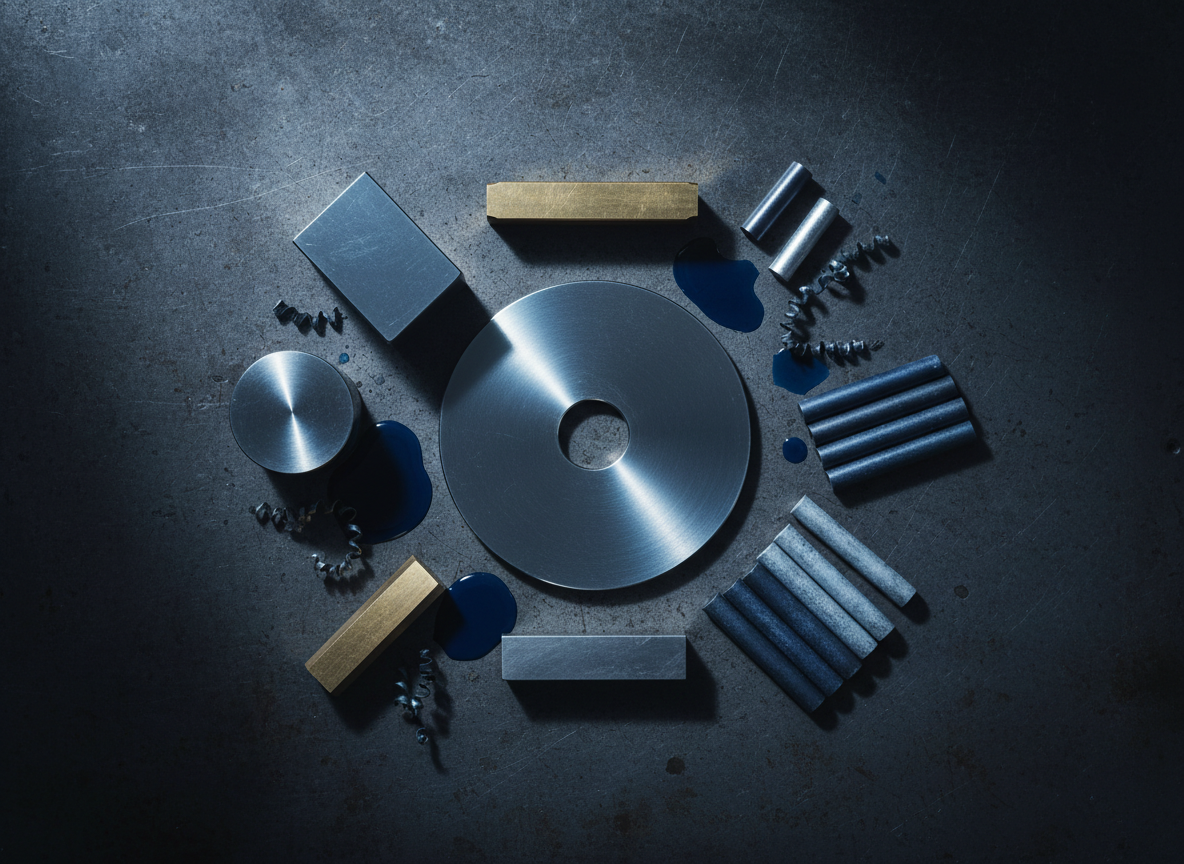
"What material should I use?" It's one of the first questions in any machining project, and the answer depends on a handful of practical trade-offs: strength, weight, corrosion resistance, machinability, and cost.
Aluminum — The Workhorse
Aluminum is the most commonly machined material for good reason. It cuts fast, produces excellent surface finishes, and is roughly one-third the weight of steel. The most popular alloy is 6061-T6 — strong, corrosion-resistant, weldable, and anodizable.
For higher-strength applications, 7075-T6 is the go-to. It's used heavily in aerospace and defense. It machines beautifully but doesn't weld well and costs more.
Best for: Lightweight parts, housings, brackets, heat sinks, prototypes, anything that needs anodizing.
Carbon Steel — Strength and Value
When you need strength and don't need corrosion resistance, carbon steel is hard to beat on price. 1018 is soft, easy to machine, and great for pins, shafts, and fixtures. 4140 is heat-treatable and used for gears, axles, and structural components that take a beating.
Best for: Structural parts, shafts, fixtures, high-load applications where the part will be painted or plated.
Stainless Steel — Corrosion Fighter
Stainless costs more and machines slower, but it resists corrosion without any coating. 303 is the free-machining grade — choose it when you can. 304 is the general-purpose grade for food, medical, and chemical environments. 316 handles salt water and harsh chemicals.
Fair warning: stainless work-hardens. Dull tools and slow feeds make it worse. A good shop knows how to push through it — sharp tools, rigid setups, and the right speeds.
Best for: Medical devices, food equipment, marine hardware, chemical processing, anything exposed to moisture.
Brass — The Precision Material
Brass machines like butter. It produces beautiful finishes, holds tight tolerances easily, and is naturally antimicrobial. 360 brass (free-cutting) is the standard for fittings, connectors, and valve components.
Best for: Fittings, connectors, decorative parts, electrical components, valve bodies.
Plastics — When Metal Is Overkill
Delrin (acetal), UHMW, nylon, and PEEK are all CNC-machinable. They're lighter than any metal, naturally insulating, and often self-lubricating. The trade-off is lower strength and thermal limits.
Best for: Insulators, bushings, wear components, food-contact parts, lightweight mechanisms.
The Decision Framework
Still not sure? Call your shop. A good machinist has cut thousands of parts in dozens of materials and can steer you to the right choice in five minutes.