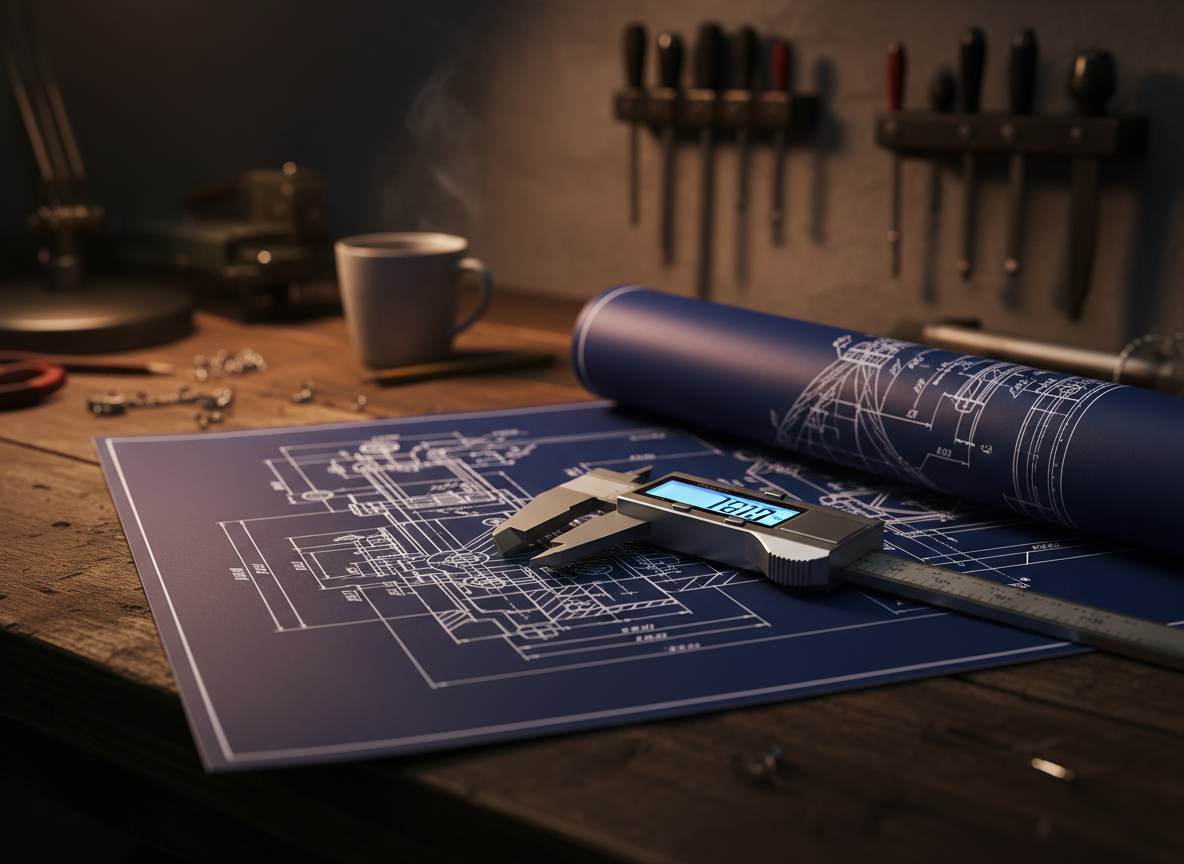
We quote hundreds of parts every month. The difference between a quote that takes 20 minutes and one that takes 3 days usually comes down to one thing: how well the drawing communicates what you need.
The Essentials — What Every Drawing Needs
1. Fully Dimensioned Views
Every feature needs a dimension. If a machinist has to guess a dimension, they'll either call you (adding days) or assume — and assumptions are where mistakes happen. Include enough views to define the complete geometry. For complex parts, isometric views help enormously.
2. Tolerances on Critical Features
Don't tolerance everything to ±0.001". Instead, call out tight tolerances only on features that matter — mating surfaces, bore fits, hole positions. Use a general tolerance note in the title block for everything else (e.g., "Unless otherwise specified: ±0.005" for dimensions, ±1° for angles").
3. Material Specification
"Aluminum" isn't enough. Specify the alloy and temper: 6061-T6, 7075-T6, 303 SS, 4140 pre-hard. If you're flexible on material, say so — it gives the shop room to suggest alternatives that might save you money.
4. Surface Finish Requirements
If you need a specific finish, call it out with Ra values. If you don't specify, you'll get standard as-machined (typically 63-125 Ra). If appearance matters, include a note or reference photo.
5. Quantity and Delivery
Include the quantity you need and when you need it. A rush job on 5 parts prices very differently from 500 parts in 6 weeks. If you're open on timing, say "best lead time" — it lets the shop fit your job into their schedule efficiently.
Bonus Points — What Makes a Great Drawing
- ▸ 3D model (STEP file) — include it alongside the 2D drawing. It helps the programmer and catches errors.
- ▸ Thread callouts — specify thread size, pitch, class, and depth. "1/4-20 UNC-2B, 0.500 deep" leaves no room for error.
- ▸ Edge break callout — "Break all sharp edges 0.010-0.015" is standard and prevents cuts during handling.
- ▸ Revision history — if you've updated the drawing, note what changed. Shops often have older revisions on file.
- ▸ Notes section — special instructions, certifications needed, packaging requirements.
Common Mistakes That Slow Down Quotes
- ✕ Sending a napkin sketch and expecting a firm price
- ✕ Missing dimensions that force the shop to call and ask
- ✕ Over-tolerancing every dimension (drives cost up unnecessarily)
- ✕ No material callout — "metal" or "steel" isn't specific enough
- ✕ Sending a 3D model with no drawing — models don't communicate tolerances
Don't Have a Drawing?
That's okay. If you have a sample part, a sketch, or even a description of what you need, send it. We can work from samples, reverse-engineer existing parts, and create drawings using our Mastercam 2020 and Geopath 3D CAD/CAM systems. It adds a step, but we do it regularly.